PROJ.

DogTrot

A superficial exploration of dynamic quadrupedal robot motion

To avoid any confusion at the onset, Project DogTrot is a purely digital project--there is no physical robot dog (yet).

Project DogTrot is a preliminary investigation into the dynamics of quadrupedal motion. A quick literature review reveals that stability in dynamic legged locomotion is still very much a developing field, and while there are a few robot quadrupeds that are well capable of this (famous examples being Boston Dynamic's Spot and MIT's MIT Cheetah), there exists an exciting amount of room for improvement and exploration in the field yet.

In DogTrot, I take the first infantile steps towards understanding the complexities of dynamic legged locomotion. DogTrot employs a very naive, intuition-heavy, first-principles approach towards achieving a stable gait within a simulated environment.

DogTrot isn't much of a project in itself, but rather a gateway into bigger things. Stay tuned for more exciting stuff!


Design Overview

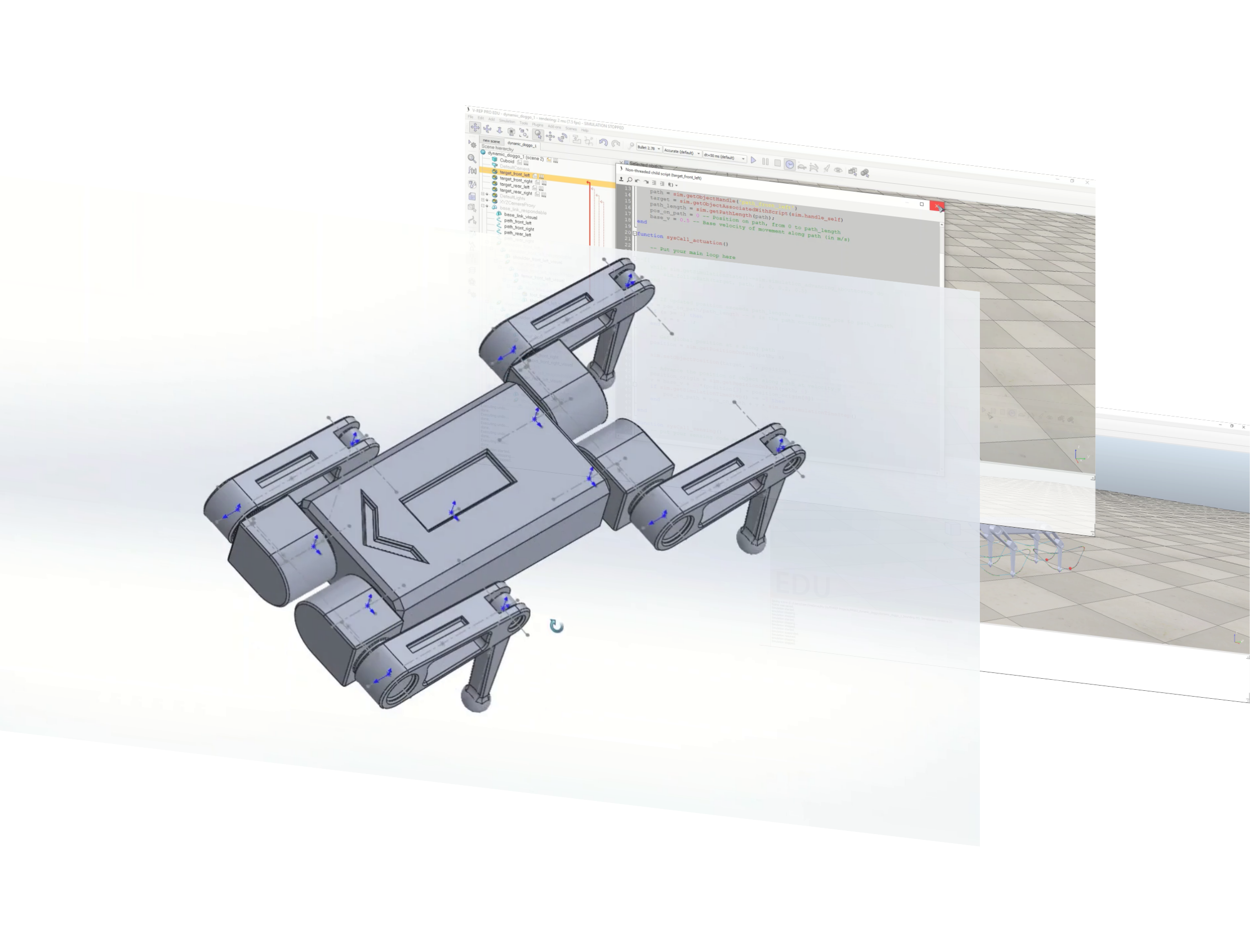
DogTrot was modelled in Solidworks, and its URDF model generated and exported thereafter. DogTrot is intentionally designed to be volumetrically symmetric with respect to its sagittal plane, with its body additionally symmetric with respect to its frontal and transverse planes. All legs share the same model, mirrored across DogTrot's sagittal plane. All parts are assigned the same homogenous material properties in the simulation.

VREP is used as the simulation environment, and Matlab the engine that drives DogTrot's movement. In VREP, LUA scripts provide object handles for manipulation in Matlab, and implement the trajectory spline each foot follows. An equivalent Matlab model of the robot dog is constructed as a tree of structure arrays, and the LUA object handles are linked to each object within this structure array. Basic object properties are registered in VREP, while motion commands are scripted in Matlab and effected in VREP.

Read more

Read more


Experiments

Stable Trot

As DogTrot was designed with symmetry in mind, I posited that a gait and foot trajectory could be designed to take advantage of this symmetry to eliminate complications in the dynamics involved. Each foot follows a vertical triangular trajectory with rounded corners that is approximately symmetric with respect to the frontal plane, with its origin a location defined with respect to the body frame (the trajectories move with and are fixed in the body frame). The gait pattern chosen is the trot, where each leg moves antagonistically 180° out of phase with respect to its closest neighbour-leg. The intention here is to eliminate or minimise moments about the anteroposterior and dextro-sinister axes of DogTrot throughout gait cycles.

It is unavoidable that DogTrot will experience sporadic rolling and pitching throughout the gait, as the antagonistic pairs of feet are not guaranteed to exert equal forces on the ground to counter each other's generated moments. To account for this, each leg is modelled to be a series-elastic actuator (SEA) stemming from the shoulder joint and extending to the foot. The idea here is that by the elastic nature of each leg, the legs on the side towards which DogTrot is rolling/pitching will, upon contact with the ground, compress more than the others and thus exert a greater force to correct for the undesirable rolling/pitching; the force exerted by a foot increases with its shoulder proximity to the ground due to the rolling/pitching of the body.

The SEA is an oscillating system, and thus has a natural frequency much lower than its rigid counterpart. It thus becomes necessary to ensure that the frequency of cyclic foot loading deviates from harmonics of this resonant frequency to avoid unbounded oscillation growth. The SEA model also features a smaller mechanical bandwidth than its rigid counterpart, which needs to encompass frequencies significantly distant from these harmonics for fast response times.

Tuning foot trajectory and cycle frequency accordingly, DogTrot is able to perform a stable gait across an arbitrary number of gait cycles.

Read more

Read more

Frantic Bound

With success in effecting a stable trot, the idea was extended to a bounding gait. However, this found very limited success, with DogTrot eventually losing control and falling over after a few successful cycles. To be honest, the implementation of the bounding foot trajectory was not very well thought-out, and I believe the large asymmetry in the trajectory design with respect to the frontal plane led to its turning turtle about the dextro-sinister axis. With more work fine-tuning the trajectories to achieve symmetry of ground forces across the frontal plane and moments about the dextro-sinister axes, a stable bounding gait could potentially be achieved with this method.

Feeble Pronk

As a little bonus, a pronking gait was attempted. As expected, the pronking gait presented the lowest risk of instability, and DogTrot was able to perform an artbitrary number of gait cycles without faltering. However, perhaps because of the lack of properly simulated traction, weak extension of the legs, and/or badly designed foot trajectory, the effected pronk was more motive than locomotive.


In Review

While this method of achieving a stable gait may have demonstrated some efficacy, there are some major limitations as to its practical applications. For one, turning during gait is nearly impossible without additional layers of control. Many conditions (as presented in the Stable Trot section) must be met in order for this approach to work, and outside of these narrow constraints the method easily falls apart.

It may be possible to expand on this method to accomodate for more directional control. However, the huge body of literature already in existence behind the problem of dynamic gait stability presents many far superior and comprehensive (albeit more involved) approaches to achieve all this and more, and it would be wiser to devote development time into de-mystifying those instead.

Regardless, this project was just a little bit of weekend fun, and the process was undeniably rewarding.